7 Unauthorized Access Prevention Karachi Tips Every Society Needs
Karachi residents used to assume that living in an upscale, gated neighborhood meant they were largely safe from break-ins. That assumption has been tested recently. Unauthorized access prevention Karachi households and societies need today has to account for a threat that isn’t just about outsiders climbing a wall, it’s increasingly about people who already have some form of access.
This article breaks down seven practical steps that actually reduce unauthorized entry, based on both local security trends and established crime-prevention guidance.
TL;DR
- Insider access, not just outsider break-ins, is now a major driver of house robberies in Karachi.
- Verified visitor and worker screening closes the biggest current gap in residential security.
- Well-lit perimeters and secured gates remain one of the simplest, most effective deterrents.
- CCTV with visible signage discourages intrusion attempts before they start.
- Reinforced doors, windows, and locks stop opportunistic entry attempts.
- Burglar alarms connected to a monitoring service catch what physical barriers miss.
- Combining these layers, rather than relying on just one, is what actually closes the gap.
Why Unauthorized Access Has Become a Bigger Risk in Karachi
Direct answer: Recent reporting shows that a rising share of house robberies in Karachi’s upscale areas involve inside access, meaning domestic staff or individuals connected to the household, not just strangers forcing their way in.
Karachi has seen a documented rise in house robberies across neighborhoods long considered secure, including Defence, Bahadurabad, and Gulshan-e-Hadeed. In several recent cases, domestic workers or individuals with inside knowledge were reportedly involved, either directly or by feeding information to outside criminal networks. Officials have acknowledged that a citywide, regularly updated verification system for domestic staff and incoming residents still doesn’t exist in any consistent form.
That gap matters because most physical security measures, walls, gates, even cameras, are built to stop outsiders. They do very little if the access came from someone already inside the perimeter.
Why This Changes How You Should Think About Prevention
If insider access is a real risk, prevention can’t stop at the front gate. It has to include how staff and long-term visitors are screened, tracked, and monitored once they’re inside. This is where a layered approach, combining human vetting with technology like access control and live security monitoring, becomes far more effective than any single measure on its own.
1. Verify Domestic Staff and Long-Term Visitors
Direct answer: Formal background checks and documented verification for domestic staff close the exact gap that’s driving many recent house robberies in Karachi.
Ask for references, ID verification, and prior employment history before hiring domestic help, and keep a simple written record. This isn’t about distrust; it’s about giving your household the same basic diligence that a professional workplace would apply before granting someone regular access.
2. Secure and Light the Perimeter
Direct answer: A well-lit, properly gated perimeter is one of the simplest and most effective ways to deter unauthorized entry before it’s attempted.
Motion-activated lighting around walls, gates, and entry points makes it much harder for anyone to approach unnoticed after dark. This is a basic but consistently recommended step in official crime-prevention guidance, and it costs far less than most other security upgrades. Pairing perimeter lighting with outdoor surveillance means any activity in that lit area is also being recorded.
3. Reinforce Doors, Windows, and Gates
Direct answer: Sturdy locks, reinforced doors, and secured windows stop the opportunistic entry attempts that make up a large share of unauthorized access incidents.
Always lock doors and windows when leaving or at night, and consider window bars or grilles on ground-floor openings. For gated societies, this extends to the main entrance and any secondary gates, service entrances, or maintenance access points that are often left unmonitored.
4. Install Visible, Monitored CCTV
Direct answer: Cameras placed at entry points, combined with visible signage, act as a genuine deterrent, and if monitored live rather than just recording, allow someone to actually respond while an incident is happening.
A camera that only records footage helps after the fact. A camera that’s actively watched by a monitoring team can trigger an alert the moment someone tries to enter without authorization. This is the core difference between passive CCTV and remote video surveillance, and it’s the single biggest upgrade most Karachi properties can make without a full security overhaul.
5. Use a Visitor Management System at the Gate
Direct answer: Logging every visitor, delivery, and contractor who enters a property or society gives management a clear record of who had access and when, which matters both for prevention and for investigating any incident.
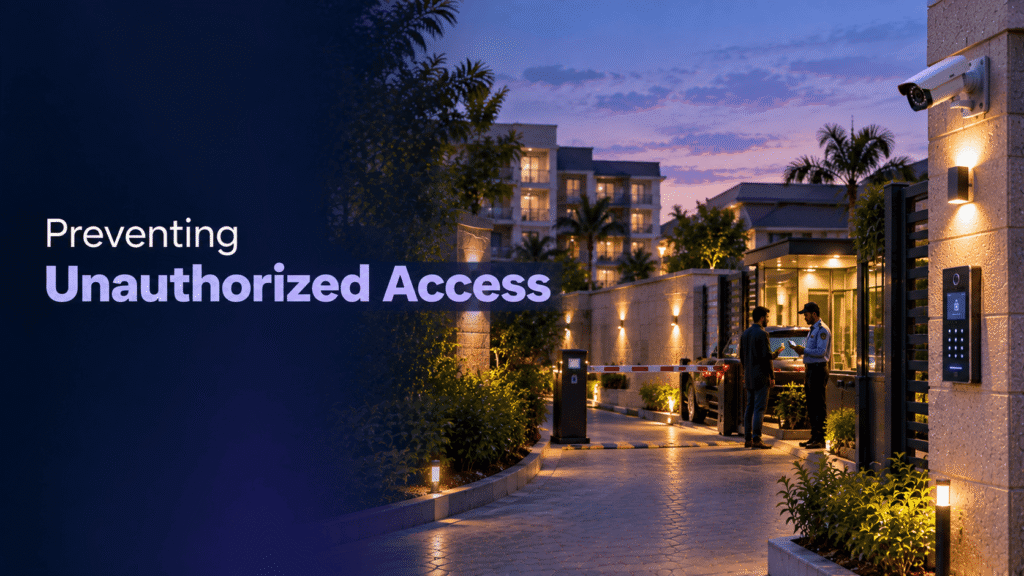
A basic sign-in log is better than nothing, but a proper visitor management system paired with an apartment doorman or intercom monitoring service verifies identity before granting entry, not just after the fact. This is especially important for gated communities where multiple households share entry points.
6. Install a Monitored Alarm System
Direct answer: A burglar alarm connected to a live monitoring service, rather than one that just makes noise locally, ensures someone actually responds when a breach is detected.
Standard advice from crime-prevention authorities recommends an alarm system connected to a monitoring service or one that alerts neighbors in case of a breach. On its own, a loud siren might scare off an opportunistic intruder, but it does nothing if nobody hears it or knows to respond. Connecting alarms to 24/7 surveillance monitoring means a trained operator is actually watching for that trigger.
7. Layer Physical, Human, and Technology Measures Together
Direct answer: No single measure, not a gate, not a camera, not a guard, fully prevents unauthorized access on its own. Combining physical barriers, verified human oversight, and active monitoring closes the gaps that any one layer leaves open.
A gate stops casual intrusion but not insider access. A camera records but doesn’t intervene unless it’s monitored. A guard can be present but unsupervised. Properties that combine remote guarding services with verified staff screening and secured entry points consistently close more gaps than properties relying on any single approach.
What to Do If You Notice an Attempted Unauthorized Entry
If you or a household member ever encounters an intruder, stay calm and prioritize safety over confrontation. Note the person’s appearance, clothing, and direction of escape, and record any vehicle details if one is used. Report the incident to police as soon as it’s safe to do so, since these reports also help authorities track patterns across neighborhoods.
Summary
Unauthorized access prevention Karachi residents need today goes beyond a strong gate and a visible camera. With insider access now a documented factor in many house robberies, real prevention means verifying who has access in the first place, securing entry points with lighting and reinforced locks, and backing all of it with actively monitored CCTV and alarms rather than passive recording alone. No single layer closes every gap, but combining verified access, physical security, and live monitoring gives Karachi households and societies a far stronger position than relying on any one measure by itself.
Frequently Asked Questions
What is the biggest cause of unauthorized access in Karachi homes right now?
Recent reporting points to insider access, cases involving domestic staff or individuals with inside knowledge, as a significant and growing factor in house robberies, alongside more traditional break-ins.
Do I really need to background-check domestic staff?
Yes. Given how often insider access has been linked to recent house robbery cases in Karachi, verifying references, ID, and prior employment history is one of the most effective steps a household can take.
Is CCTV alone enough to prevent unauthorized access?
Not fully. Recorded-only CCTV helps after an incident, but actively monitored CCTV allows someone to respond while it’s happening, which is a meaningfully stronger deterrent and a faster way to stop an incident in progress.
What should a gated community do differently from a single household?
Gated communities need visitor management at shared entry points, verified worker access for maintenance and staff, and monitored CCTV covering all gates, not just the main one, since secondary entrances are often the weakest point.
How does lighting actually help prevent break-ins?
Well-lit perimeters remove the cover of darkness that unauthorized entry typically relies on, and motion-activated lighting specifically draws attention to movement near walls, gates, and entry points during low-visibility hours.
Should alarms be connected to a monitoring service or just sound locally?
A monitored alarm is significantly more effective, since a local siren alone depends on someone nearby hearing and responding, while a connected monitoring service can dispatch help immediately.
What should I do if I catch someone attempting unauthorized entry?
Prioritize your safety first. Avoid direct confrontation if possible, note the person’s appearance and escape direction, and contact the police as soon as it’s safe. Trying to physically intervene carries real risk.